
The retail space at its heart is the best possible connection to a consumer. It’s where you can actually give them a reason to believe in the brand itself.
– Sean Langford, Transformation Lead, Jigsaw
For years it’s been the same old story. A story that didn't end well for the physical store.
Because, you see (if you believe everything you read and hear), stores were on borrowed time, ecommerce would take over, and high streets would empty.
That’s not what happened.
On Thursday, October 15, 2026, we brought retailers and partners together over breakfast at the Pan Pacific in London for Retail Revelations, co-hosted with OneStock and AbsoluteLabs. We wanted to try to answer one simple question - why are retailers betting on their stores again?
It’s not because life has got easier.
James O’Hare, our VP of Sales, opened with the numbers he’d heard from Helen Dickinson of the British Retail Consortium a few weeks earlier. Compared with last year, UK retailers are facing around 20% higher taxes and 16% higher employment costs. Energy is 40% more expensive than in the next-cheapest market. And supply chains, once the place to claw back margin, have been turned upside down by geopolitics.
So why the optimism? Because stores have been underinvested in for 15 to 20 years. That makes them one of retail’s biggest untapped revenue drivers.
Here’s what we learned.
1. The shopper walking in has already done the homework
Melissa Minkow from CI&T called herself the “American opposite” of the BRC’s outlook. Her take is that with great challenges comes great opportunity.
Her research, drawn from 2,000 UK and Ireland consumers across 2025 and 2026, painted a picture of a shopper who feels the pinch but is more in control than ever.
- 80% expect prices on most goods to keep rising over the next few years.
- 87% say they’re making smarter purchase decisions than before. For UK shoppers, smarter means better value.
- 68% have used an AI agent at some point while shopping, from research to discovery to buying. 57% of those who haven’t are open to it.
- 69% say AI helps them be smarter about what they buy.
Having said all of this, most UK shoppers say AI isn’t making them shop more. They’re shopping the same, or less, and spreading their money more strategically. (In the US, it’s the opposite.)
Melissa called it the end of the impulse era.
The biggest shift is that the path to purchase used to run discovery, research, buy. Now it runs research, discovery, buy.
Shoppers start by asking an agent, a search engine, or (increasingly) platforms like TikTok. That widens their options late in the journey, right before they convert. So they’re more open to new brands than ever. Yet, oddly, they also say they’re more brand loyal. Because when they do choose you, it’s a conscious decision.
Agentic commerce hasn’t replaced the store - people are using AI agents for research. What’s changed is the shopper who is walking through the door.
- Apps and stores were roughly tied as the preferred place to start shopping.
- In 7 of 13 categories, shoppers would rather start instore.
- 20% say they would never complete a purchase inside an AI agent. Those who would mostly stick to routine buys like groceries, beauty and personal care.
People still want to press the buy button themselves. And trust, Melissa argued, takes a long time to earn.
Shopping has always been a balancing act between quality, price, and convenience. Price gets you in the door. It’s the entry point and the trial driver. But inventory availability, fast fulfillment, and knowledgeable store staff are what bring people back.
And whatever habits shoppers pick up online, they carry into the store with them. Today’s customer arrives already knowing what they want. They’ve compared the options.
So the stakes are higher. And the experience has to be worth the trip.
2. Stores are winning the budget again
Sean Langford leads transformation at Jigsaw, across retail, ecommerce and pretty much every piece of technology in the business. And he’s seen the money move.
Three or four years ago, ecommerce projects got the funding. Not anymore. Jigsaw is opening new stores, including in Ireland, often with smaller footprints that balance location against cost.
Why? Because a customer can buy a jumper in plenty of places. They need a reason to buy it from you. That’s an emotional connection, and the store is where you build it best. Storytelling around product that’s only really possible face to face.
There’s a commercial case too. Online, customers buy on price. In store, Sean said, they’re far more likely to pay full price. Meanwhile, ecommerce returns and operating costs keep climbing.
42 stores. One day.
Then came the moment that made a few people in the room sit up. Jigsaw rolled out Sitoo POS across all 42 UK stores in a single day.
Sean admitted the board met the plan with stony silence. He spent months preparing for everything that could go wrong. It didn’t. He called it the easiest rollout of his career.
So what made the difference?
- Training in-house. Jigsaw made regional managers and senior staff the experts. That mattered for a team that wasn’t always comfortable with new tech.
- Investing in the hardware. The real nuts and bolts were the kit. Jigsaw used the moment to refresh it, so stores looked as modern as the system behind them.
- Letting stores shape the outcome. Mobile POS and clienteling were high on the wish list. In practice, stores preferred their fixed points and wrapping areas. Sean took it as a lesson in listening to the people who’ll use the system every day.
The goal throughout was to adopt technology that doesn’t get in the way of what stores do best.
An AI layer, built in a month
Jigsaw has just launched an AI layer that sits on top of its ERP. It came together in about a month and wasn’t on any roadmap.
The early wins are practical. Store teams have built better rota systems with it. But the bigger prize is letting anyone ask the business a question in plain language. Which style of jumper sold best over the last five years? Ask, and get an answer.
Sean was clear that an AI layer is only as good as the data behind it. That’s why the unglamorous work of connecting best-of-breed systems, like OneStock and Sitoo, matters so much.
Here were Sean’s top pieces of advice:
- Have a vision, not a rigid map. Accept that things will change, and be ready to pivot.
- Get things live. Elegant solutions are nice. Live ones give you feedback from the business.
- Invest in relationships. With a connected stack, your suppliers are long-term partners. You want them to keep getting better.
3. The store is being reinvented, not replaced
Our closing panel looked at the store through three lenses. The shop floor, with Laura Webb, Flagship Store Manager at Dune London. Retail operations, with Nathan Hambridge, Senior Retail Operations Manager at Paul Smith. And technology, with Simon Suarez, Director of Enterprise Architecture at AbsoluteLabs.
Store teams need answers, fast
Laura has been with Dune for eight years. She’s seen the shift from pen and paper to an iPad. And she’s seen customers change with it.
They won’t wait a week. They don’t accept “no” as an answer. They want it today or tomorrow at the latest.
Ship-from-store used to take Dune up to ten days. With OneStock, it now takes as little as an hour. Customers place an order in the morning and collect it on their lunch break.
That speed shows up at peak too. In Dune’s first Black Friday with OneStock, more than 400 parcels came into stores in under five days. And when a product goes viral on a Friday and sells out online by Saturday night, stores can still sell their stock on Monday morning.
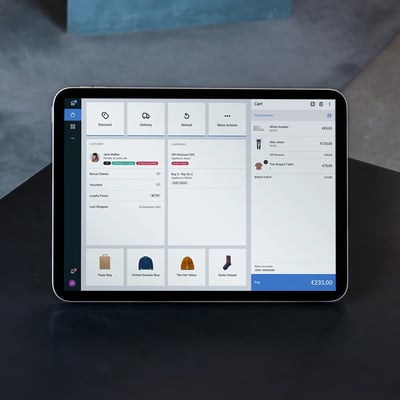
Laura’s team does this all with a single, simple iPad. With fewer people on the shop floor than ten years ago, time is everything. Tech that new starters can pick up on their own is worth its weight in gold.
Close the gap between online and in store
For Nathan, the biggest risk is treating online and stores as separate channels. Customers don’t see two businesses. They see Paul Smith.
That gap shows up fast. A promotion online that isn’t in store. Separate budgets and objectives pulling against each other. Push digital hard enough without investing in the store, and customers start to wonder why they’d visit at all.
As part of Paul Smith’s move to Sitoo over the last six to eight months, product information and imagery now flow in from Centra. Any associate can look up the full catalog, check stock anywhere in the country, and swipe through the same images a shopper sees online. It’s also brought the store and digital teams much closer together.
Give people a reason to come in
If shoppers do their research with AI, the store has to offer something an agent can’t.
Paul Smith recently took over the Corner Shop at Selfridges for two weeks, recreating Paul’s famously packed office in the Oxford Street windows, with Paul himself working inside, happily waving passersby in, much to his assistants’ dismay.
It’s part of a wider approach. Oysters and champagne outside the Notting Hill store. Whisky tastings. Live drawing. Nathan described many of Paul Smith’s stores as more like museums than shops. The point isn’t to make people spend. It’s to make them want to come.
Start with the data, and keep the human touch
For retailers stuck on legacy systems, Simon’s advice was to decouple. Put an integration layer between your legacy back office and a modern commerce layer, and build a reliable single view of customer and stock. Then peel the onion, one tangible business benefit at a time. New tech for its own sake doesn’t cut it.
Looking at the next 12 months, he expects personalized, omnichannel promotions and loyalty to take center stage.
On AI, he split it in two. Operationally, it’s already helping stores and head offices make better decisions. Customer-facing, it needs more care. His 13-year-old daughter, a budding artist, can’t stand AI. Use AI to curate, Simon said, but don’t trade away the human connection.
What it all adds up to.
We know shoppers are better informed than ever. They arrive having done the research, and they expect the store to keep up.
That means associates need the full picture at their fingertips, online and in store need to work as one business, and it should be an experience worth leaving the house for.
None of that works without connected systems and clean data underneath. That’s where the real transformation happens. Not in the flashy front end, but in the plumbing that lets a store team answer “yes”.
Of course the store isn’t dying. It never has been. It’s simply being reinvented.
Want to dig into the numbers? CI&T’s full research report is available on their website. And if you’d like to join us at the next Retail Revelations, get in touch.
Last updated: oktober 29, 2026