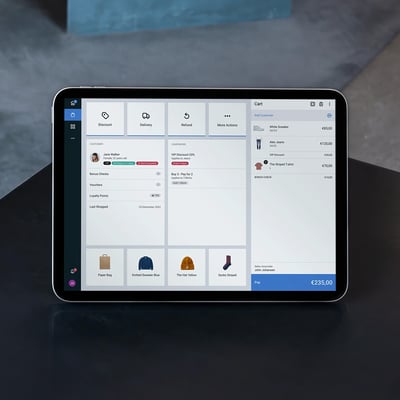

POS upgrades used to be treated like system replacements.
A new checkout. A new interface. A new way to process sales and returns.
But that view is too small for where retail is heading.
The latest Gartner® Market Guide for Unified Commerce Platforms Anchored by AI-Enabled POS for Tier 2 Retailers points to a bigger opportunity and sees POS modernization as a strategic move toward more agile, intelligent, and connected store operations.
So, what should retailers be thinking about?
Here’s a practical checklist based on the Market Guide recommendations.
1. Treat your POS upgrade as a strategic store transformation project
A POS upgrade is not just an IT project.
It is a chance to rethink how your stores operate, how your associates serve customers, and how your business uses data across every channel.
The Market Guide recommends positioning POS upgrades as a strategic opportunity to modernize store infrastructure with embedded AI capabilities that enhance agility, intelligence, and associate enablement.
That means asking questions that go beyond transactions
Ask:
- Can it help associates serve customers from anywhere in the store?
- Can it give teams real-time access to inventory, customer, product, and order data?
- Can it support AI capabilities?
- Can it scale with our business as stores, channels, and customer expectations change?
- Can it make life easier for both customers and store teams?
The goal is not just to replace old technology. It’s to create smarter stores.
2. Make associate enablement a core requirement
Store associates are the face of your brand. Your brand champions.
They’re also being asked to do more than ever: sell, advise, fulfill, return, exchange, check availability, support loyalty, and keep customers happy.
That’s why associate enablement should be at the center of any POS or unified commerce evaluation.
Your checklist:
- Can associates access everything they need from one interface?
- Does the platform support mobile-first workflows?
- Can associates check inventory across stores and channels in real time?
- Can they complete checkout from the shop floor?
- Can they support click and collect, ship from store, and returns without switching systems?
- Can AI help them find answers faster or recommend the next best action?
This is where the idea of a single pane of glass becomes so important.
When products, inventory, customers, orders, promotions, and checkout live in one connected experience, associates can stop wrestling with systems and start focusing on customers.
3. Look for central orchestration across unified commerce
Unified commerce is not about adding more systems. It’s about making every system work together.
The Market Guide recommends investing in unified commerce solutions that provide central orchestration and seamless connectivity across essential unified commerce capabilities.
In practice, this means your POS should not sit alone.
It should connect with the wider retail ecosystem, including ecommerce, inventory, order management, customer data, loyalty, payments, promotions, and fulfillment.
Your checklist:
- Does the platform connect stores, ecommerce, and marketplaces in real time?
- Does it support one source of truth for product, inventory, order, customer, and sales data?
- Can it integrate with existing ERP, CRM, PIM, OMS, and ecommerce systems?
- Does it support API-first integration?
- Can it help reduce silos between teams and channels?
- Can it support future use cases without heavy custom work?
A connected store depends on connected systems.
Without central orchestration, teams end up with more workarounds. With it, every channel can move from the same shared reality.
4. Involve store operations and customer experience leaders early
POS decisions should not happen in isolation.
The Market Guide recommends partnering with store operations and customer experience leaders to evaluate solutions with a proven track record of improving store fulfillment and delivering superior customer service.
That matters because these teams understand what happens on the shop floor every day.
They know what good service looks like when the store is full, the queue is building, and an online order needs to be found fast.
Your checklist:
- Have store operations leaders been involved in the evaluation?
- Have customer experience leaders reviewed the workflows?
- Have store associates tested the interface?
- Have you mapped key journeys such as returns, click and collect, endless aisle, and assisted selling?
- Have you considered how the platform supports both peak trading and everyday operations?
- Have you validated that the technology works for real stores, not just perfect demo scenarios?
The best technology does not just look good in a presentation. It works when the store is busy.
5. Assess resilience, disaster recovery, and security
When POS becomes the front line of unified commerce, resilience becomes business-critical.
The Market Guide recommends assessing a vendor’s disaster recovery features to establish whether it can deliver cloud-native POS solutions with adequate resilience, data security, and privacy.
This is especially important when stores rely on real-time data, connected workflows, and mobile-first tools to serve customers.
Your checklist:
- What happens if connectivity drops?
- Can stores keep selling offline?
- How does the platform recover after disruption?
- What disaster recovery capabilities are in place?
- How is data protected?
- How does the platform support privacy and compliance requirements?
- Can the vendor support business continuity across markets?
Modern retail needs technology that keeps stores moving. A great customer experience depends on reliability, not just functionality.
6. Check whether the platform is ready for what comes next
Retail will not stand still. Customer expectations will keep changing. AI capabilities will keep evolving. New channels, fulfillment models, and store experiences will continue to emerge.
That is why flexibility matters.
Your checklist:
- Is the platform cloud-native?
- Is it API-first?
- Does it support composable architecture?
- Can it integrate with best-of-breed systems?
- Can it evolve without major upgrade projects?
- Can new capabilities be introduced quickly?
- Can the retailer control its pace of innovation?
The right platform should not trap you in yesterday’s retail model. It should help you move toward tomorrow’s.
Access the Market Guide
Want to explore the recommendations and trends shaping the next generation of AI-enabled POS and unified commerce platforms?
Access your copy of the Gartner® Market Guide for Unified Commerce Platforms Anchored by AI-Enabled POS for Tier 2 Retailers.
Gartner disclaimer
Gartner, Market Guide for Unified Commerce Platforms Anchored by AI-Enabled POS for Tier 2 Retailers, By Kelsie Marian, Max Panther Hammond, 27 October 2025.
GARTNER is a registered trademark and service mark of Gartner, Inc. and/or its affiliates in the U.S. and internationally and is used herein with permission. All rights reserved.
Gartner does not endorse any vendor, product or service depicted in its research publications, and does not advise technology users to select only those vendors with the highest ratings or other designation. Gartner research publications consist of the opinions of Gartner’s research organization and should not be construed as statements of fact.
Gartner disclaims all warranties, expressed or implied, with respect to this research, including any warranties of merchantability or fitness for a particular purpose.
Last updated: september 18, 2026